Skip to content


Abstract
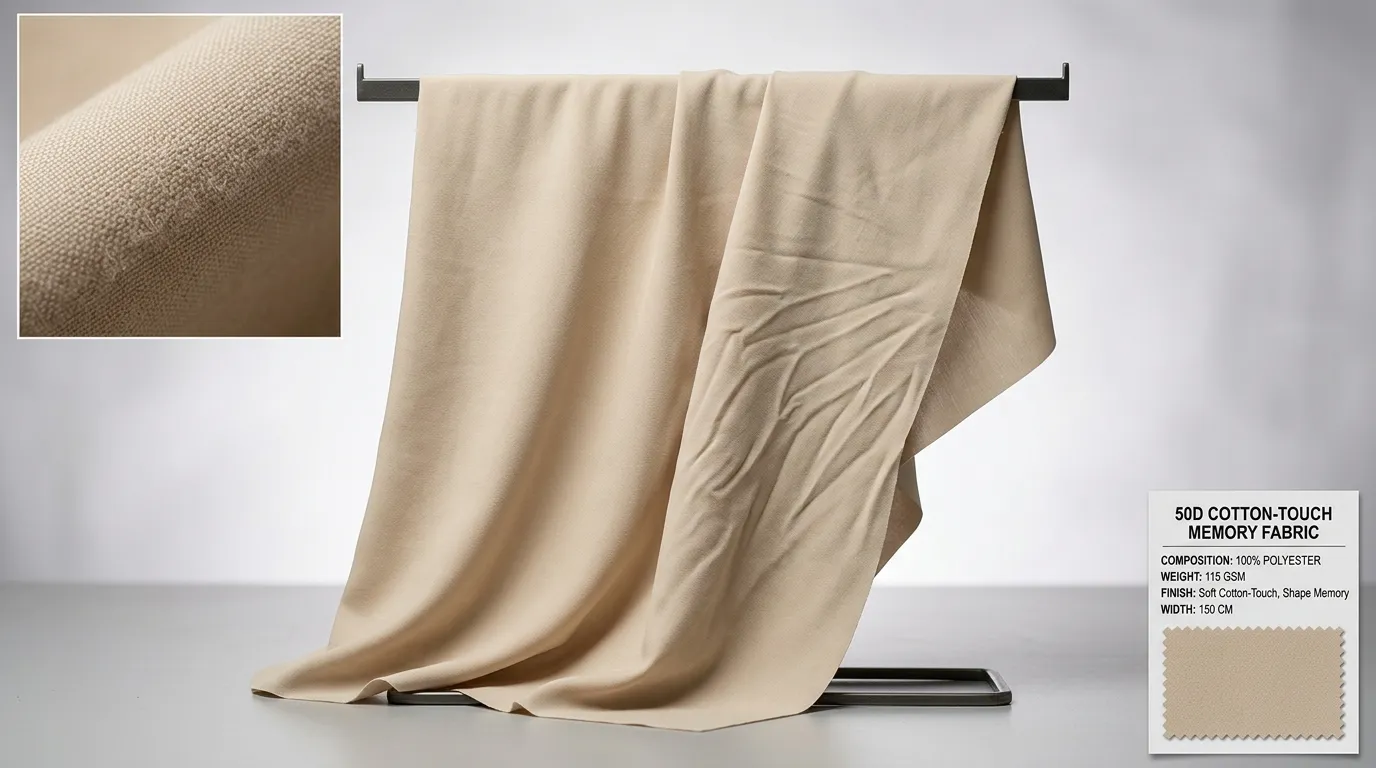
50D Cotton-Touch Memory Fabric combines the soft hand-feel of cotton with the resilient memory properties of synthetic fibers, offering a unique textile solution for applications requiring both comfort and shape retention. This article explores its technical composition, performance characteristics, industry standards, and commercial applications in apparel, outdoor gear, and functional textiles.
Understanding 50D Cotton-Touch Memory Fabric Technology
Material Composition and Fiber Structure
The “50D” designation refers to the denier measurement—specifically, a 50-denier yarn where 9,000 meters of fiber weighs 50 grams. This lightweight specification positions the fabric in the ultra-fine category, delivering exceptional softness while maintaining structural integrity. The cotton-touch characteristic derives from specialized surface treatments applied to synthetic base fibers, typically a polyester-nylon blend in ratios ranging from 85/15 to 70/30, depending on the desired memory recovery rate.
The manufacturing process involves texturizing synthetic filaments through air-jet or false-twist methods, creating microscopic surface irregularities that mimic cotton’s natural fiber structure. A proprietary finishing treatment—often involving silicone-based polymers or enzymatic washing—further enhances the tactile resemblance to natural cotton. Unlike traditional cotton blends that incorporate actual cotton fibers (which compromise memory function), this fabric achieves cotton-like softness through engineered surface modification while preserving the synthetic core’s elastic recovery properties.
The fiber architecture utilizes bi-component or tri-component yarn construction, where the core consists of high-tenacity polyester for dimensional stability, surrounded by lower-melting-point nylon that provides the shape-memory mechanism. During heat-setting processes at temperatures between 180-200°C, the nylon component develops crystalline structures that “remember” the fabric’s original configuration, enabling wrinkle recovery after compression or folding.
Memory Function Mechanism
The memory effect operates through thermoplastic molecular behavior inherent to synthetic polymers. When subjected to mechanical stress—such as folding, crushing, or wrinkling—the polymer chains temporarily deform but retain molecular “memory” of their heat-set orientation. At ambient temperatures above the fabric’s glass transition point (typically 60-80°C for nylon components), these chains gradually realign to their original configuration through entropic relaxation.
This recovery process occurs in two phases: immediate elastic recovery (30-50% within 30 seconds) and delayed viscoelastic recovery (complete restoration within 2-8 hours, depending on ambient temperature and humidity). The 50D construction accelerates recovery compared to heavier deniers because thinner fibers possess higher surface-area-to-volume ratios, facilitating faster heat transfer and molecular mobility.
Comparative testing against standard woven polyester demonstrates superior crease recovery angles—typically 140-160° for memory fabric versus 90-110° for conventional synthetics (measured per AATCC Test Method 66). Unlike natural cotton, which exhibits permanent deformation under repeated stress due to cellulose fiber breakage, the synthetic memory fabric maintains 85-92% recovery efficiency even after 50 compression cycles.
Technical Specifications and Performance Metrics
Physical Properties and Testing Standards
50D Cotton-Touch Memory Fabric typically exhibits a fabric weight ranging from 60-85 GSM (grams per square meter), positioning it as a lightweight to mid-weight textile suitable for layering applications. Tensile strength testing per ASTM D5034 (grab test method) reveals breaking forces of 180-220N in the warp direction and 160-200N in the weft direction—adequate for garment construction while maintaining drape characteristics.
Tear resistance, measured according to ISO 13937-2 (trouser tear method), typically ranges from 25-35N, indicating moderate resistance to propagation tears. This specification suits applications where controlled flexibility is prioritized over heavy-duty industrial use. Abrasion resistance testing using the Martindale method (ISO 12947) shows endurance ratings between 15,000 and 25,000 cycles before visible fiber degradation, comparable to mid-range polyester fabrics but superior to cotton blends of equivalent weight.
Performance Parameter Comparison
| Property | 50D Cotton-Touch Memory | Standard 50D Polyester | Cotton Blend (50/50) |
|---|---|---|---|
| Weight (GSM) | 65-80 | 70-85 | 120-140 |
| Stretch Recovery (%) | 88-92 | 75-82 | 45-60 |
| Wrinkle Resistance (AATCC 124) | Grade 4.0-4.5 | Grade 3.5-4.0 | Grade 2.0-2.5 |
| Breathability (g/m²/24h) | 3,500-4,200 | 2,800-3,500 | 5,000-6,500 |
| Durability Cycles (Martindale) | 20,000 | 25,000 | 8,000-12,000 |
Moisture vapor transmission rates (MVTR) measured per ASTM E96 demonstrate breathability values of 3,500-4,200 g/m²/24h—lower than natural cotton but significantly higher than coated synthetic membranes, making the fabric suitable for moderate-activity applications where ventilation is essential.
Compliance and Certifications
Reputable manufacturers supply 50D Cotton-Touch Memory Fabric with OEKO-TEX Standard 100 certification, confirming the absence of harmful substances across all production stages. This certification is particularly critical for skin-contact applications, as it restricts formaldehyde content to below 75 ppm and prohibits carcinogenic dyes.
REACH (Registration, Evaluation, Authorization, and Restriction of Chemicals) compliance ensures that all chemical treatments—including the cotton-touch finishing agents and dyestuffs—meet European Union safety standards. Buyers targeting EU markets should verify SVHC (Substances of Very High Concern) declarations from suppliers.
For specialized applications, flame-retardant variants are available that meet NFPA 701 or EN ISO 15025 standards through inherent FR polymer additives or topical treatments. However, these treatments may slightly alter the cotton-touch hand-feel and should be specified during procurement. Sustainability-focused buyers can source variants with Global Recycled Standard (GRS) certification when post-consumer recycled polyester comprises the base fiber, though this may increase unit costs by 15-25%.
Commercial Applications and Use Cases
Apparel and Fashion Industry
The travel wear segment represents the primary market for 50D Cotton-Touch Memory Fabric, where wrinkle resistance directly translates to consumer value. Business travelers prioritize garments that maintain a professional appearance after prolonged packing—shirts, trousers, and blazers constructed from this fabric emerge from luggage with minimal creasing, reducing reliance on hotel ironing services. The lightweight 50D construction also minimizes baggage weight, a critical factor for frequent flyers.
Business casual garments benefit from the fabric’s dual performance: the cotton-touch surface provides workplace-appropriate aesthetics and comfort, while the memory function ensures day-long wrinkle resistance during extended wear. Unlike traditional cotton dress shirts that develop creases at elbow and back stress points, memory fabric maintains a smooth appearance through 8-10 hour workdays.
In activewear applications, the fabric serves primarily as a lining material for jackets and performance outerwear. The moisture-wicking properties (though inferior to specialized technical fabrics) combined with soft hand-feel create comfortable next-to-skin experiences, while the lightweight construction doesn’t add bulk. The memory function proves particularly valuable in packable athletic jackets that compress into integrated stuff sacks—garments recover their shape within hours of unpacking, eliminating the “crushed” appearance common to standard nylon shells.
Outdoor and Technical Gear
Lightweight trekking jackets utilize 50D Cotton-Touch Memory Fabric as face fabric or liner, where the 65-80 GSM weight provides optimal warmth-to-weight ratios for three-season use. The fabric’s compressibility—typically achieving 4:1 compression ratios in stuff sacks—makes it ideal for backpacking applications where pack volume is constrained. Upon deployment at camp, the memory function restores loft and appearance without requiring field pressing.
Packable travel bags and duffels leverage the fabric’s crease recovery to maintain professional appearance despite repeated folding. Unlike coated nylon that develops permanent crease lines, memory fabric retains smooth aesthetics across hundreds of pack-unpack cycles. The cotton-touch surface also provides superior grip compared to slick polyester, reducing slippage when bags are stacked or carried.
Camping equipment manufacturers incorporate the fabric into compressible pillows, sleeping bag liners, and tent storage bags. The soft hand-feel enhances comfort in skin-contact applications, while the memory properties ensure items regain functional shape after compression storage. The fabric’s moderate abrasion resistance suits these applications where durability requirements are less extreme than industrial-grade gear.
Sourcing Considerations for B2B Buyers
Quality Assessment Criteria
Procurement teams should require ISO 9001-certified manufacturers with documented quality management systems covering fiber sourcing, weaving/knitting, finishing, and final inspection. Request third-party test reports for critical specifications—tensile strength, colorfastness (ISO 105-C06 for wash fastness, minimum Grade 4), and dimensional stability after washing (maximum 3% shrinkage per ISO 6330).
Sample evaluation protocols should include:
- Hand-feel assessment: Compare against approved standards under controlled humidity (65% RH)
- Memory recovery testing: Fold samples at 180° for 24 hours, then measure the recovery angle after 4 hours
- Colorfastness validation: Conduct accelerated wash testing (5 cycles) to verify dye stability
- Fabric weight verification: Confirm GSM within ±5% tolerance using calibrated scales
Minimum order quantities typically range from 500-1,500 meters for stock colors, increasing to 2,000-3,000 meters for custom dyeing. Lead times vary by customization level: 15-25 days for in-stock materials, 35-50 days for custom colors, and 60-75 days for specialized finishes (e.g., water repellency, anti-microbial treatments).
Establish clear acceptance criteria in purchase orders, including permissible defect rates (typically 2-3 defects per 100 linear meters for Grade A fabric), shade variation tolerances (ΔE ≤ 1.0 for critical color matching), and packaging requirements to prevent transit damage.
Cost-Benefit Analysis
50D Cotton-Touch Memory Fabric typically commands pricing 25-40% above standard 50D polyester taffeta, with FOB costs ranging from $2.80-$4.50 per meter depending on order volume and finishing specifications. While initial material costs are higher, the total cost of ownership analysis reveals advantages:
Durability benefits: The 20,000-cycle Martindale rating translates to 2-3 years of regular use in apparel applications versus 1-1.5 years for cotton blends, reducing replacement frequency and long-term procurement costs.
Maintenance savings: Wrinkle-free properties eliminate or reduce ironing requirements, lowering energy costs in hospitality uniforms or rental garment services. Commercial laundries report a 30-40% reduction in pressing time compared to cotton blends.
Brand positioning: The premium hand-feel and performance characteristics support higher retail price points—garments can command 15-25% price premiums over standard synthetic alternatives, improving margin potential for brands.
Customization options include solution-dyed fibers (superior colorfastness, +$0.40-0.60/meter), durable water repellent (DWR) finishes (+$0.30-0.50/meter), and anti-microbial treatments (+$0.25-0.40/meter). Evaluate these additions against specific use-case requirements—DWR proves cost-effective for outdoor applications but is unnecessary for interior apparel.
Volume discounts typically apply at 5,000-meter thresholds (5-8% reduction), 10,000 meters (10-12% reduction), and 25,000+ meters (15-18% reduction). Strategic buyers can consolidate multiple SKUs into single production runs to achieve volume pricing while maintaining color/finish variety through batching.
FAQ
Q1: How does 50D Cotton-Touch Memory Fabric differ from regular polyester memory fabric?
The primary distinction lies in surface treatment and tactile properties. Regular polyester memory fabric maintains a synthetic, smooth hand-feel characteristic of thermoplastic fibers, while 50D Cotton-Touch Memory Fabric undergoes specialized finishing processes—typically enzymatic treatments or micro-sanding—that create surface texture mimicking cotton’s natural fiber irregularities. This results in a softer, more natural hand-feel without compromising the underlying memory mechanism.
Performance-wise, 50D Cotton-Touch Memory Fabric may exhibit slightly reduced tensile strength (5-8% lower) due to surface modification but offers superior consumer acceptance in direct-skin-contact applications. The memory recovery rates remain comparable, with both achieving 85-92% wrinkle recovery within standard timeframes. For brands targeting premium comfort segments, 50D Cotton-Touch Memory Fabric provides a compelling balance between aesthetics and functionality.
Q2: What is the typical lifespan of garments made from 50D Cotton-Touch Memory Fabric under normal use?
Under normal wear conditions (defined as 2-3 wears per week with monthly washing at 30-40°C), garments constructed from 50D Cotton-Touch Memory Fabric demonstrate functional lifespans of 24-36 months before noticeable performance degradation. The memory function remains effective through approximately 100-150 wash cycles, after which recovery rates decline to 70-80% of original performance.
Physical wear typically manifests as surface pilling (after 150-200 wear cycles) and a gradual reduction in cotton-touch hand-feel due to finish degradation. Proper care—avoiding high-heat drying, using mild detergents, and minimizing mechanical agitation—can extend lifespan to 40-48 months. Commercial applications with daily wear (uniforms, workwear) should anticipate 12-18 month replacement cycles when using 50D Cotton-Touch Memory Fabric.
Q3: Can 50D Cotton-Touch Memory Fabric be dyed or printed using standard textile processes?
Yes, 50D Cotton-Touch Memory Fabric accepts conventional dyeing and printing methods with minor process adjustments. For piece dyeing, disperse dyes work effectively on the polyester component at 120-130°C using high-temperature jet dyeing equipment. The cotton-touch finish typically withstands standard dyeing temperatures, though some softness reduction (10-15%) may occur—post-dye softening treatments can restore hand-feel.
Digital printing and screen printing perform well using disperse or pigment inks, with heat fixation at 180-200°C. Sublimation transfer printing yields excellent results on light-colored bases. Critical consideration: the memory function requires heat-setting post-dyeing at 185-195°C for 30-45 seconds to restore optimal recovery properties, as dyeing processes can temporarily disrupt molecular orientation. When sourcing 50D Cotton-Touch Memory Fabric, consult suppliers for specific dye recipe recommendations, as finish chemistry may interact with certain dye classes.
Conclusion
50D Cotton-Touch Memory Fabric represents a strategic convergence of consumer-desired aesthetics and performance functionality, addressing market demands for low-maintenance textiles that don’t sacrifice wearing comfort. The dual advantages of cotton-like tactile appeal and wrinkle-resistant memory properties position this material as a versatile solution for brands seeking differentiation in competitive apparel and technical gear markets.
For procurement teams, key selection factors center on verified performance testing (particularly memory recovery rates and colorfastness), supplier certifications ensuring chemical compliance, and total cost analysis that accounts for extended durability and reduced maintenance requirements. While unit costs exceed standard synthetics by 25-40%, the value proposition strengthens in applications where wrinkle resistance, packability, and premium hand-feel drive consumer purchasing decisions. 50D Cotton-Touch Memory Fabric consistently outperforms alternatives in these demanding scenarios.
Strategic sourcing should prioritize suppliers offering customization flexibility—solution dyeing, specialized finishes, and scalable MOQs—while maintaining rigorous quality controls. As sustainability pressures intensify, buyers should evaluate recycled-content variants and suppliers with transparent environmental management systems. The technical performance of 50D Cotton-Touch Memory Fabric, combined with growing consumer preference for easy-care textiles, ensures continued relevance across travel wear, business casual, and outdoor equipment segments through evolving market cycles.