Skip to content


Introduction
Are you looking for a fabric that combines structure with mobility for performance apparel? T800 low elasticity fabric is designed to deliver the crisp, shape-holding look of rigid polyester while offering the flexibility and recovery that traditional polyester cannot provide.
The global activewear market was valued at approximately $416 billion in 2025, according to Grand View Research, and is projected to maintain strong growth through 2032. Consumers now expect garments that perform as well during a morning run as they do in an office setting, with features like moisture-wicking, lightweight construction, and long-lasting durability becoming baseline requirements.
Unlike high-elastane stretch fabrics that lose resilience over time, T800 fabric uses a specialized bicomponent fiber structure—typically a blend of PBT and PET—forming a durable three-dimensional crimp. This gives controlled stretch, exceptional recovery, a soft cotton-like hand feel, and excellent dye retention. For brands seeking both performance and longevity, T800 low elasticity fabric offers a reliable upgrade over rigid polyester.
What Is T800 Low Elasticity Fabric?
T800 low elasticity fabric is a high-performance polyester designed for garments that need both structure and flexibility. Unlike rigid polyester, which offers no stretch, T800 uses a bicomponent fiber structure—typically a blend of PBT (polybutylene terephthalate) and PET (polyethylene terephthalate). During heat treatment, the fibers shrink at different rates, forming a three-dimensional crimp that provides controlled stretch and reliable recovery.
This gives the fabric a soft, cotton-like hand feel, excellent dye affinity, and long-lasting shape retention. Ideal for performance apparel, workwear, uniforms, and outdoor garments, T800 avoids sagging, color fading, and microplastic shedding, making it a durable, low-maintenance alternative to spandex-based fabrics.

How the T800 Low Elasticity Fabric Is Built Differently
T800 fabric’s performance comes from its bicomponent fiber architecture. PBT and PET filaments are extruded side by side. During heat treatment, differential shrinkage forces the fibers into a permanent three-dimensional helical crimp, providing controlled elasticity and consistent recovery. Unlike elastane, this crimp is permanent, resisting degradation from heat, UV, or repeated washing.
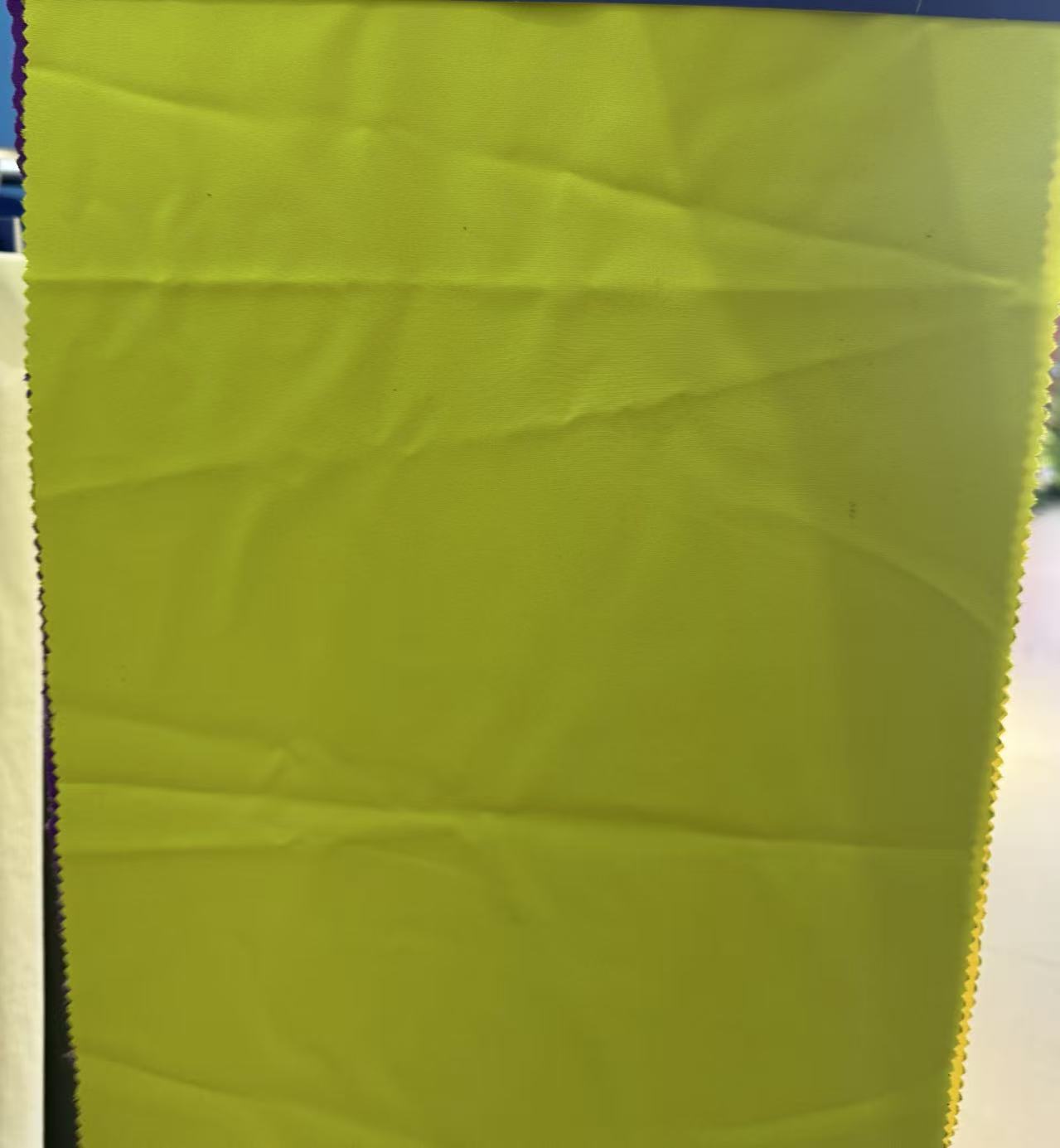
Our 75D low-elasticity T800 fabric weighs 145 g/m² with a 142 cm width, balancing mechanical strength, comfort, and efficient cutting yields. Fully polyester, it combines fast drying, colorfastness, wrinkle resistance, and easy care, moving naturally with the body without sagging or stretching. Many brands replace rigid polyester with T800 to improve garment performance and longevity.
T800 low elasticity fabric vs. rigid polyester
Here is where the rubber meets the road. If you are deciding between T800 low elasticity fabric and rigid polyester for your next outerwear or casual wear project, the table below lays out the differences clearly.
| Performance Attribute | T800 Low Elasticity Fabric | Rigid Polyester |
|---|---|---|
| Stretch & Mobility | Controlled low elasticity (8–15%); moves with the body without over-extension | Zero stretch; no give during movement |
| Recovery after wear | Excellent; fabric returns to its original dimensions even after repeated use | N/A — no stretch to recover from |
| Comfort during activity | High; fabric flexes at knees, elbows, and shoulders | Low; restricts motion, feels stiff |
| Wrinkle resistance | Superior; maintains smooth appearance | Very good, but at the cost of mobility |
| Drape & hand feel | Soft, cotton-like, with natural drape | Stiffer, sometimes plastic-like feel |
| Breathability | Good; engineered for moisture vapor transmission | Poor; traps heat and moisture |
| Durability | Excellent abrasion resistance with built-in resilience | Very durable, but fabric fatigue can occur at stress points |
| Dyeing performance | Excellent saturation and colorfastness | Good, but requires higher temperatures |
| Best applications | Outdoor jackets, performance pants, casual suits, travel wear | Structured outerwear, bags, industrial uses, and budget apparel |
The biggest difference is not just that T800 fabric stretches — it is how it stretches and recovers. With rigid polyester, the wearer has to fight the garment to move. With the T800 low elasticity fabric, the garment works with the wearer. It gives enough to allow a full range of motion, then immediately returns to its original shape. No sagging knees. No baggy elbows. No stretched-out seat after a long day of wear. That consistent recovery is what makes T800 low elasticity fabric a true performance material, not just another stretch polyester.
Design advantages for apparel brands: Form meets function
For brands, switching from rigid polyester to T800 low elasticity fabric unlocks new design possibilities without sacrificing any of the structural integrity that polyester is known for.
-
Tailored silhouettes that move
One of the biggest challenges in performance apparel design is balancing a flattering, tailored fit with functional mobility. A jacket that looks sharp on a mannequin can feel restrictive on a real body. T800 fabric solves this problem because its low elasticity is precisely calibrated — enough stretch to accommodate natural body movement, but not so much that the garment loses its shape or looks slouchy. This makes it ideal for products like tailored travel blazers, commuter pants, and soft-shell jackets where both aesthetics and performance matter. In each of these applications, T800 low elasticity fabric outperforms rigid alternatives without adding bulk.
-
Wrinkle-free travel wear
Nothing beats the wrinkle resistance of polyester, and T800 fabric retains that advantage while adding mobility. For travel apparel brands, this is a game-changer. Garments made from T800 low elasticity fabric can be packed tightly, unfolded, and worn immediately with no ironing required. And because the fabric moves with the wearer, those long-haul flights and cross-country train rides become significantly more comfortable.
-
Aesthetics that sell
Let us talk about the look and feel. T800 fabric offers a fine surface texture and a soft, almost cotton-like hand feel — not the plasticky touch that consumers often associate with budget polyester. The low-elasticity construction also gives the fabric excellent drape, meaning it hangs naturally on the body rather than sticking out stiffly. From a retail perspective, these tactile qualities translate directly into higher perceived value and better sell-through.
-
Color that lasts
Dyeing performance is another area where T800 fabric excels. The 100 percent polyester composition takes dye readily and holds it with excellent fastness. Unlike elastane blends that can yellow over time or lose color vibrancy after repeated washing, T800 fabric maintains its saturation wash after wash. For brands concerned with long-term product quality and customer satisfaction, this is a significant advantage.
Application scenarios: Where T800 low elasticity fabric delivers real value
The versatility of T800 low elasticity fabric makes it suitable for a wide range of end-use applications. Here are some of the most promising scenarios.
-
Outdoor casual clothing
Outdoor jackets, windproof pants, and soft-shell garments demand a fabric that balances protection with mobility. T800 fabric delivers on both fronts. The low-elasticity construction allows for comfortable layering and unrestricted movement during hiking, climbing, or daily commuting. When laminated with a breathable membrane, the fabric offers waterproof and windproof protection while allowing sweat vapor to escape — keeping the wearer dry without feeling stuffy. Designers who have worked with T800 low elasticity fabric often note how easily it integrates with membranes and linings compared to rigid polyester.
-
Daily casual pants and outerwear
For everyday pants, suits, and casual jackets, the combination of moderate elasticity, durability, and wrinkle resistance makes T800 fabric an excellent choice. Consumers are increasingly looking for garments that transition seamlessly from office to evening to weekend, and T800 fabric supports that lifestyle. It offers a fashionable appearance, true wearing comfort, and easy-care maintenance — all in one fabric.
-
Athleisure and performance wear
The athleisure market alone is projected to grow from roughly $403 billion in 2026 to $845 billion by 2034. T800 fabric is perfectly positioned to capture a share of this growth. Its moisture-wicking properties, thanks to the dual-component structure that creates micro-grooves for capillary action, keep the wearer dry during low- to medium-intensity activities. The fabric breathes better than rigid polyester and recovers faster than many spandex blends. For athleisure brands that want to move beyond basic poly-spandex blends, T800 low elasticity fabric offers a more refined hand feel and longer shape retention.
Compared with generic polyester knits that use minimal elastane, T800 feels much livelier at the same body temperature and shows far less bagging at high-wear areas like elbows and knees. Against cotton-spandex jerseys, T800 dries significantly faster and maintains its shape through repeated laundering. And when compared with nylon-spandex blends, T800 offers better color retention and a drier, less clingy hand feel — particularly valuable in hot studio environments or during summer outdoor activities.
Sustainability and certification: Meeting modern brand requirements
Sustainability is no longer a niche concern. By 2026, an estimated 35 percent of athleisure products are projected to incorporate recycled or sustainable materials, reflecting the growing environmental consciousness of consumers. Leading brands are increasingly requiring third-party certifications to validate their sourcing claims.
T800 fabric can be produced using recycled polyester inputs, aligning with circular economy principles. The 100 percent polyester composition means that T800 fabric is technically recyclable at the end of life — an important consideration for brands developing closed-loop programs. Choosing T800 low elasticity fabric over elastane-based fabrics also reduces the risk of microplastic shedding from degraded elastic fibers, a factor increasingly monitored in EU and North American regulations.
For brands that require assurance of responsible production, our T800 low elasticity fabric is available with OEKO-TEX STANDARD 100 certification. This globally recognized standard screens textiles for over 1,000 harmful substances — far exceeding typical regulatory requirements. From banned azo dyes to heavy metals and PFAS compounds, the certification gives brands and their customers confidence that the fabric is safe for skin contact.
Bluesign certification is another relevant standard for premium brand positioning. Products carrying the bluesign PRODUCT label assure the highest level of consumer safety, minimum environmental impact during production, and responsible use of resources.
For sourcing teams, the key takeaway is this: T800 low elasticity fabric can meet the sustainability requirements of premium and mass-market brands alike, with third-party certifications available to back up your claims.
Manufacturing and quality control: What to look for when sourcing T800 fabric
Not all T800 fabric is created equal. The performance of the final fabric depends heavily on the quality of the base fiber, the precision of the knitting or weaving process, and the finishing treatments applied.
Here are a few things to check when evaluating T800 fabric suppliers:
-
Fiber source consistency: Ask about the origin and grade of the bicomponent polyester. Higher-quality fiber translates directly into better elasticity recovery and longer garment life.
-
Fabric weight and width: Confirm that the supplier can deliver consistent weight and width across production runs. The 75D specification with 145 g/m² weight offers proven performance for outerwear and casual apparel applications.
-
Color fastness testing: Request third-party test reports for color fastness to washing, light, and perspiration. T800 fabric should deliver excellent scores across all three.
-
Stretch and recovery data: Ask for laboratory data showing stretch percentage and recovery rate after multiple cycles. A reputable supplier will have this information available.
-
Certifications: Confirm OEKO-TEX STANDARD 100, bluesign, or other relevant certifications based on your brand requirements.
FAQ
1. Is T800 low elasticity fabric suitable for high-intensity sports?
T800 is ideal for low-to-medium intensity activities and lifestyle apparel. For high-intensity compression sports like running or CrossFit, fabrics with higher elasticity may be more appropriate.
2. How does T800 fabric compare with T400 fabric?
T800 provides about 10% better elastic recovery than T400, with a softer, cotton-like hand feel and improved moisture-wicking performance.
3. Can T800 fabric be recycled at the end of its life?
Yes. Being 100% polyester, T800 is compatible with existing polyester recycling streams, supporting sustainable garment production.
4. Does T800 require special care when washing?
No. T800 fabric is machine washable and resistant to shrinkage and deformation. Use standard polyester care: cold or warm wash, low-tumble dry.
5. Is T800 suitable for summer apparel?
Yes. Its bicomponent fiber structure creates micro-channels for moisture wicking and airflow, making it more breathable than rigid polyester.
Conclusion: Make the Switch to T800 Low Elasticity Fabric (Optimized)
Rigid polyester solved problems around shape and durability, but it has always fallen short on comfort and mobility. Today’s apparel market no longer accepts that trade-off. Garments are expected to support movement, manage moisture, and maintain a clean appearance across work, travel, and outdoor use. T800 low elasticity fabric was developed to meet that shift.
By combining controlled low elasticity with strong recovery, a soft hand feel, and stable dye performance, T800 offers a practical upgrade over conventional polyester constructions. The 75D version, with a weight of 145 g/m² and a width of 142 cm, is already being used in performance apparel, workwear, and casual wear applications where both structure and comfort are required.
If you are evaluating new fabric options, requesting samples is usually the most direct way to assess performance differences in real production conditions. Our team can provide technical support, sample development, and specification guidance based on your end-use requirements.