Vai al contenuto

Introduzione
Sourcing fabric for outdoor gear, workwear, or activewear often means compromise: you can have strength, stretch, or softness—but rarely all three. Regular polyester is strong but stiff. Spandex blends stretch but lose elasticity. Nylon is durable but costly, and traps heat.
T800 polyester fabric changes the game. This bicomponent mechanical stretch fiber delivers high strength without bulk, lasting elasticity without spandex, and a soft, cotton-like feel that outperforms regular polyester, T400, and even cotton in drying speed and durability.
In this guide, we break down how T800 polyester fabric outperforms standard materials—with clear comparisons, technical insights, and real-world applications for performance apparel, workwear, and outdoor gear.
The Core Problem with Regular Fabrics: Strength, Stretch, and Softness Don’t Mix
Let’s start with the problem that T800 polyester fabric is designed to solve. Most traditional fabrics force unavoidable compromises.
Regular polyester (standard PET) is strong and inexpensive, but it offers almost no natural stretch. Its round, smooth fiber structure can feel stiff or slightly scratchy, and it tends to trap heat and moisture against the skin. For workwear or outdoor jackets, this is acceptable—but for garments that need movement and comfort, it becomes a limitation.
Spandex blends (elastane + polyester or nylon) improve stretch, but introduce durability issues. Spandex degrades under chlorine, UV exposure, and high heat. Over time, it loses elastic recovery, leading to sagging knees, loose waistbands, and overall “bagging” effect. In addition, dye uptake can be inconsistent, sometimes causing subtle color variation between batches.
Nylon delivers excellent abrasion resistance, but comes at a higher cost—often nearly double that of polyester. It also requires special treatment for UV resistance, and its moisture management is generally weaker than that of polyester in long-duration wear.
Cotone is comfortable and breathable, but it wrinkles easily, shrinks after washing, absorbs moisture, and dries slowly. These limitations make it unsuitable for high-performance or wet-weather applications.
T800 polyester fabric was developed to eliminate these trade-offs. It is a 100% polyester material, making it chemically stable and recyclable within polyester streams. Its PBT/PET bicomponent structure creates permanent mechanical stretch—no elastane required. In addition, its engineered grooved fiber cross-section enhances moisture wicking while maintaining a softer, more comfortable hand feel compared to standard polyester.

What Exactly Is T800 Polyester Fabric? A Technical Breakdown
T800 polyester fabric is not a marketing name for regular polyester. It’s a specific type of bicomponent fiber made from two different polyesters: PBT (polybutylene terephthalate) and PET (polyethylene terephthalate).
These two materials have different shrinkage rates. When the fiber is drawn and heat‑set, the PBT component shrinks less than the PET component, causing the fiber to curl into a three‑dimensional spiral. That spiral is what gives T800 its mechanical stretch. No elastane. No chemical cross‑linking. Just physics.
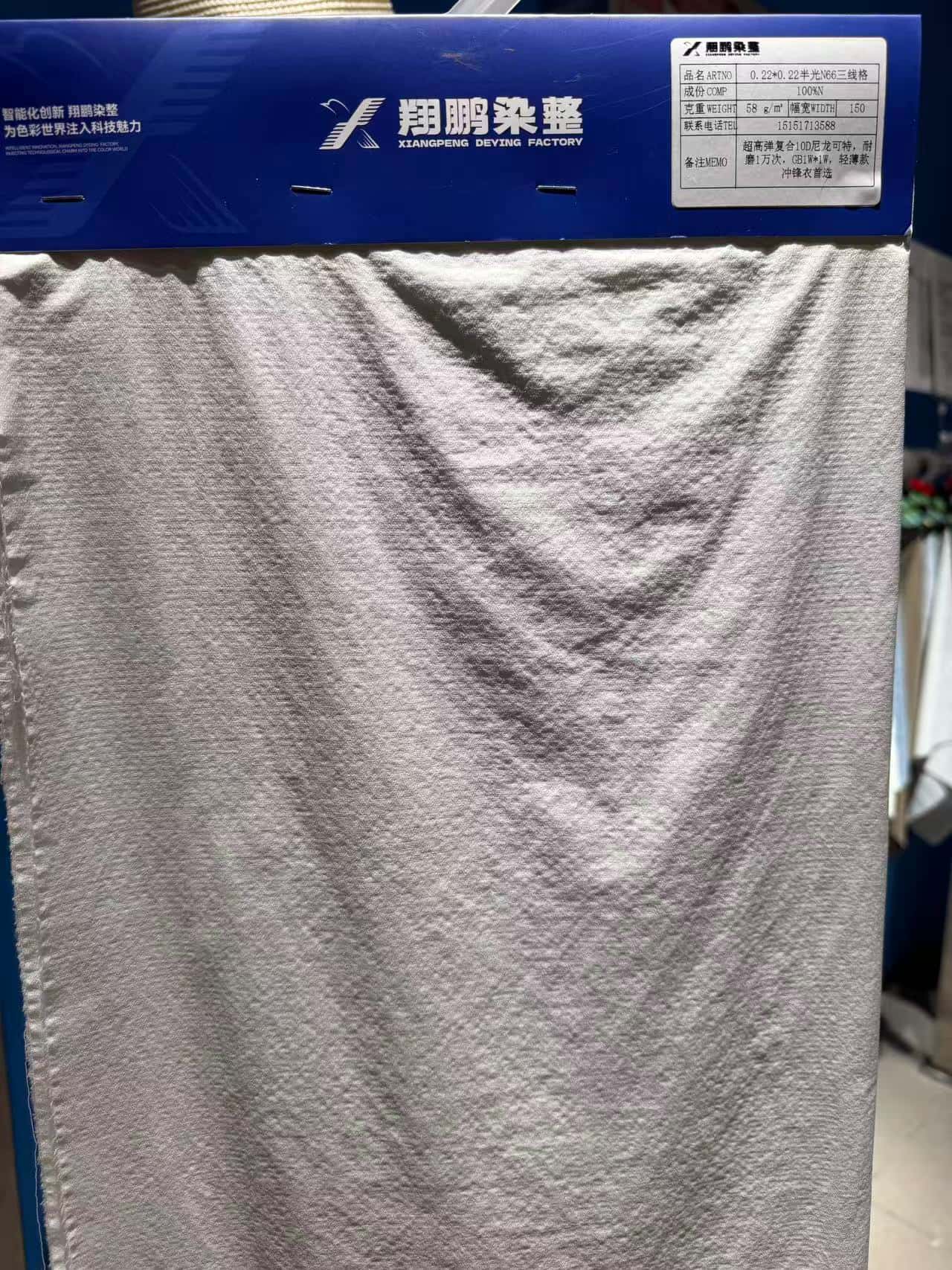
The 75D single‑warp double‑weft construction (as seen in the reference product) creates a balanced, durable weave. The “double weft” means two weft yarns per pick, increasing fabric density and tear strength without adding excessive weight. This structure is particularly well‑suited for applications that need both stretch and abrasion resistance.
Key technical specifications of T800 polyester fabric:
-
Breaking strength: 18 cN/dtex (approximately 1.8× higher than T400)
-
Elastic recovery: 10% better than T400 after repeated stretching
-
Permanent deformation: <3% after 50,000 stretch cycles
-
Moisture wicking: 2× faster than regular polyester; 8× faster than cotton
-
Stretch percentage: 20–30% mechanical stretch (varies by weave)
-
Hand feel: Fully matte finish, soft and cotton‑like
Regular polyester has a round fiber cross‑section. T800 polyester fabric uses an eight‑shaped groove cross‑section. Those grooves create capillary channels that pull sweat away from the skin and spread it across the fabric surface for rapid evaporation. That’s why T800 feels drier and cooler than regular polyester in active wear.
T800 vs. Regular Polyester: Side‑by‑Side Comparison
Here is a direct comparison between T800 polyester fabric and standard polyester (PET) fabric of similar weight and construction.
| Proprietà | Regular Polyester (PET) | T800 Polyester Fabric |
|---|---|---|
| Stretch type | None (requires elastane blend) | Mechanical (bicomponent spiral) |
| Stretch percentage | 0–5% (inherent) | 20–30% |
| Elastic recovery after stretching | N/A | <3% permanent deformation after 50,000 cycles |
| Breaking strength (cN/dtex) | ~10 (varies) | 18 |
| Moisture wicking | Moderato | 2× faster |
| Drying speed | 4× faster than cotton | 8× faster than cotton |
| Hand feel | Smooth, sometimes slick or scratchy | Soft, cotton‑like, fully matte |
| Dye uptake | Buono | Excellent, vivid colors |
| Spandex content | Often 5–15% | 0% |
| resistenza ai raggi UV | Fiera | Better than nylon; consistent with polyester |
| Chlorine resistance | Moderate (spandex in blends degrades) | High (no spandex) |
| Costo | Basso | Moderate (¥4–5/m less than T400) |
Regular polyester alone cannot provide stretch. That’s why most “stretch” polyester fabrics are actually polyester‑spandex blends. T800 polyester fabric eliminates the spandex, which means it also eliminates spandex’s weaknesses: chlorine sensitivity, UV degradation, and elastic fatigue.
In practical terms, a pair of work pants made from regular polyester‑spandex will start to bag out at the knees after 20–30 washes. A pair made from T800 polyester fabric will maintain its shape for hundreds of washes. That’s not a small difference. That’s a fundamental durability upgrade.
Where Spandex Blends Fail (And T800 Polyester Fabric Excels)
Spandex (elastane) has been the industry standard for adding stretch to fabrics for over 60 years. But it has four major weaknesses that T800 polyester fabric solves completely.
Weakness #1: Chlorine destroys spandex.
Swimming pools, hot tubs, and even residual chlorine in tap water break down elastane polymers. Swimwear lasts one season. Workwear washed in municipal water loses stretch within months. T800 contains zero spandex, so chlorine has nothing to attack.
Weakness #2: UV exposure degrades spandex.
Sunlight breaks elastane bonds. Outdoor gear that sits in the sun—backpack straps, tactical vests, construction vests—loses elasticity long before the fabric wears out. T800 polyester fabric resists UV degradation far better than any spandex blend.
Weakness #3: High heat during drying damages spandex.
The label says “tumble dry low” for a reason. High heat permanently sets spandex into a stretched or shrunken state. T800 handles normal drying temperatures without losing its mechanical stretch.
Weakness #4: Spandex blends lose recovery over time.
Every stretch cycle slightly deforms elastane fibers. After enough cycles, the garment simply doesn’t snap back. That’s why old yoga pants sag at the knees. T800’s bicomponent mechanical stretch maintains >97% recovery after 50,000 cycles.
Beyond these four, spandex blends also have aesthetic problems. Elastane doesn’t take dye the same way polyester does, leading to subtle color variations (barre) in solid‑color fabrics. Spandex also yellows with age and UV exposure. T800 polyester fabric, being 100% polyester, dyes uniformly and resists yellowing.
One more advantage: T800 is easier to recycle. Spandex blends are notoriously difficult to recycle because separating elastane from polyester is uneconomical. T800 polyester fabric is mono‑material, making it compatible with existing polyester recycling streams. That’s a real sustainability benefit, not just marketing.
Key Performance Advantages of T800 Polyester Fabric
Let’s go beyond comparisons and list what T800 polyester fabric actually does better than regular fabrics—in application terms.
1. Mechanical stretch without spandex. This is the headline feature. Regular fabrics need elastane to stretch; T800 doesn’t. The stretch comes from the fiber’s spiral crimp, which is set during manufacturing and doesn’t wash out.
2. Superior shape retention. Because the stretch is mechanical and not dependent on rubbery polymers, T800 returns to its original dimensions after stretching. Workwear reinforced with T800 polyester fabric keeps its fit shift after shift, wash after wash.
3. High tensile strength for demanding applications. At 18 cN/dtex breaking strength, T800 is stronger than T400 and most standard polyesters. That means fewer fabric failures in high‑stress areas like knees, elbows, and seat panels.
4. Fast moisture wicking and quick drying. The eight‑groove cross‑section pulls sweat away from skin and spreads it for rapid evaporation. T800 polyester fabric dries eight times faster than cotton and twice as fast as regular polyester.
5. Soft, cotton‑like hand feel. Regular polyester can feel plasticky or slippery. T800’s fully matte finish and fiber geometry create a soft, natural feel that consumers prefer for next‑to‑skin applications.
6. Excellent dye uptake and colorfastness. T800 takes dye more evenly than spandex blends and holds color through repeated washing. Vivid, saturated colors are easier to achieve.
7. Resistance to chlorine and UV. Without spandex, T800 polyester fabric shrugs off pool chlorine and sunlight. That makes it suitable for swimwear, outdoor workwear, and marine applications where regular blends fail quickly.
8. Lower cost than T400 and nylon. T800 greige fabric costs ¥4–5 per meter, less than T400, and significantly less than nylon. You get premium performance without the premium price tag.
Real‑World Applications: Who Uses T800 Polyester Fabric?
T800 polyester fabric isn’t theoretical. It’s already replacing regular fabrics in demanding applications.
Outdoor gear and softshell jackets
Softshell jackets need wind resistance, water repellency, breathability, and unrestricted movement. T800 delivers 20–30% stretch, waterproof ratings exceeding 5,000mm H₂O in laminated versions, and a comfortable next‑to‑skin feel. Brands producing hiking pants, climbing pants, and softshell jackets are switching to T800 for its combination of durability and comfort.
Workwear and industrial protective clothing
Construction workers, warehouse staff, and utility workers need pants that survive concrete, brick, and sharp edges. Regular cotton or poly‑cotton pants tear quickly. Regular polyester‑spandex pants bag out. T800 polyester fabric offers tear strength and shape retention that lasts for years. It can also be laminated with antistatic or flame‑retardant coatings for specialized industrial environments.
Tactical gear and military uniforms
Military and law enforcement gear demands high strength, low weight, and freedom of movement. T800 is used in tactical trousers, combat shirts, body armor carriers, and backpack shells. Its mechanical stretch allows a full range of motion without adding bulk or spandex.
Athleisure and performance apparel
The line between gym wear and daily clothing has blurred. T800 polyester fabric is common in stretch chinos, hiking trousers, running jackets, and commuter pants. It offers all‑day comfort with breathability and shape retention that regular cotton or stretch blends can’t match.
Backpacks, bags, and outdoor accessories
High tensile strength and tear resistance make T800 ideal for backpack shells, tent outer layers, travel luggage, and utility bags. The fabric can be coated or laminated without losing its mechanical stretch properties.
Functional fashion (techwear)
Tech‑wear brands have embraced T800 for its modern aesthetic, durable finish, and comfortable drape. Urban tech jackets, tapered cargo pants, and weather‑resistant dresses all benefit from T800’s performance and appearance.
Swimwear and water sports gear
Because T800 polyester fabric has no spandex, it resists chlorine degradation. Swimwear made from T800 lasts multiple seasons without losing elasticity or color. Rash guards, dive skins, and triathlon suits are natural applications.
Medical textiles and compression garments
Some grades of T800 are used in medical compression wear where consistent pressure is required without elastane’s fatigue. The mechanical stretch provides uniform, long‑lasting compression.
Cost and Value Analysis: Is T800 Worth the Investment?
Price is always a consideration. T800 polyester fabric sits in a specific position on the cost‑performance curve.
| Material | Approximate cost per yard (greige) | Performance level | Best use case |
|---|---|---|---|
| Standard polyester | Basso | Base | Budget apparel, linings |
| Polyester‑spandex blend | Low‑moderate | Moderate stretch, limited durability | Activewear, casual pants |
| T400 polyester | Moderato | Entry mechanical stretch | Mid‑range outdoor wear |
| T800 polyester fabric | Moderate (¥4–5/m less than T400) | High stretch, high durability | Premium outdoor, workwear |
| Nylon (e.g., Cordura) | Alto | Alta resistenza all'abrasione | Heavy‑duty packs, tactical gear |
T800 greige fabric costs ¥4–5 per meter less than T400. That doesn’t sound like much, but over a production run of 10,000 meters, it saves $5,000–$6,000. And the T400 is already considered a value‑conscious choice for mechanical stretch.
Compared to nylon, T800 polyester fabric is roughly half the price while offering comparable strength and better moisture management. The trade‑off is that nylon has higher abrasion resistance for extreme applications. For most outdoor and workwear uses, T800’s abrasion resistance is more than sufficient.
The real value comes from longevity. A garment made from T800 polyester fabric lasts two to three times longer than a standard polyester‑spandex garment before showing signs of bagging, pilling, or seam failure. Over the lifetime of a uniform program or a consumer’s use, the total cost of ownership is lower—even if the upfront fabric cost is slightly higher.
For brands, there’s an additional value: the ability to market “elastane‑free stretch” and “better recyclability.” Consumers increasingly care about microplastic pollution from synthetic fabrics. Spandex blends shed microfibers and are hard to recycle. T800 polyester fabric, being 100% polyester, addresses both concerns.
How to Maintain T800 Polyester Fabric for Maximum Lifespan
T800 polyester fabric is durable, but proper care extends its life even further.
Washing. Use cold or warm water (below 40°C / 104°F). Hot water can gradually set wrinkles and reduce mechanical stretch over many cycles, though T800 is more heat‑resistant than spandex blends. Use mild detergent. Avoid bleach—it’s unnecessary for polyester and can damage any applied coatings (like DWR).
Drying. Tumble dry on low heat or hang dry. High heat is not recommended for any performance fabric, though T800 handles it better than spandex. For laminated waterproof versions, line drying is best to preserve membrane integrity.
Stain removal. T800 resists staining well. Treat spots promptly with mild soap and water before washing. For oil‑based stains, a dab of dish soap works.
Waterproof or DWR coatings. If your T800 polyester fabric garment has a durable water repellent (DWR) finish, avoid fabric softeners. They clog the coating and reduce water beading. Reapply DWR spray when water stops beading on the surface.
Storage. Store garments flat or folded in a cool, dry place away from direct sunlight. Prolonged UV exposure eventually degrades any synthetic, though T800 resists UV better than nylon or spandex blends.
A mistake to avoid: Do not use chlorine bleach for stain removal. It won’t damage the T800 polyester itself, but it will destroy any elastane in trims (like waistband elastic) and will degrade DWR coatings. Stick to oxygen bleach (sodium percarbonate) if you need whitening.
With reasonable care, a garment made from T800 polyester fabric will easily last 5–10 years of regular use. For workwear that gets washed weekly, expect 3–5 years before noticeable wear—far longer than standard poly‑cotton or spandex blends.
Conclusion: When to Choose T800 Polyester Fabric Over Regular Fabrics
If you need stretch that lasts, high strength without added weight, and a soft, cotton-like feel while maintaining synthetic durability, T800 polyester fabric is the solution. It eliminates spandex, offering better recyclability, chlorine resistance, and long-term performance.
It may not be the best choice for extremely abrasive applications—nylon performs better—or for ultra-low-cost, single-season products, where standard polyester suffices. Natural fiber breathability for low-intensity hot-weather wear may also favor cotton or linen.
For most applications—hiking pants, workwear, tactical uniforms, swimwear, athleisure, or techwear—T800 delivers a combination of strength, elasticity, and comfort that regular fabrics cannot match. It stretches better than spandex blends, dries faster than cotton, and costs less than T400 and nylon.
Ready to elevate your product line? Whether designing outdoor, performance, or workwear apparel, T800 polyester fabric provides the durability and comfort your customers will notice.